Disclosure: WhatAllSay is reader-supported. Some links on this page are affiliate links, and we may earn a commission if you buy through one at no extra cost to you. That never changes what we write, and it never changes a score.
Pulsetto is a good fit if you want a short, low-effort calming routine and you can judge it inside the 30-day money-back window. Buyers rate it 4.1 out of 5 across 3,469 Trustpilot ratings. Device-specific clinical evidence is still limited, so treat it as a wellness habit rather than a treatment.
How we made this estimate
Compiled from six sources between 12 and 17 October 2026. We read Pulsetto's own product, pricing, refund and contraindication pages; cart-tested its current public discounts; counted 3,469 verified buyer ratings on Trustpilot; weighed three independent hands-on tests that ran from several weeks to three months; and checked peer-reviewed research on cervical and auricular vagus nerve stimulation.
We did not use the device ourselves, so every claim about how it feels is attributed to the source that reported it.
What Pulsetto actually is
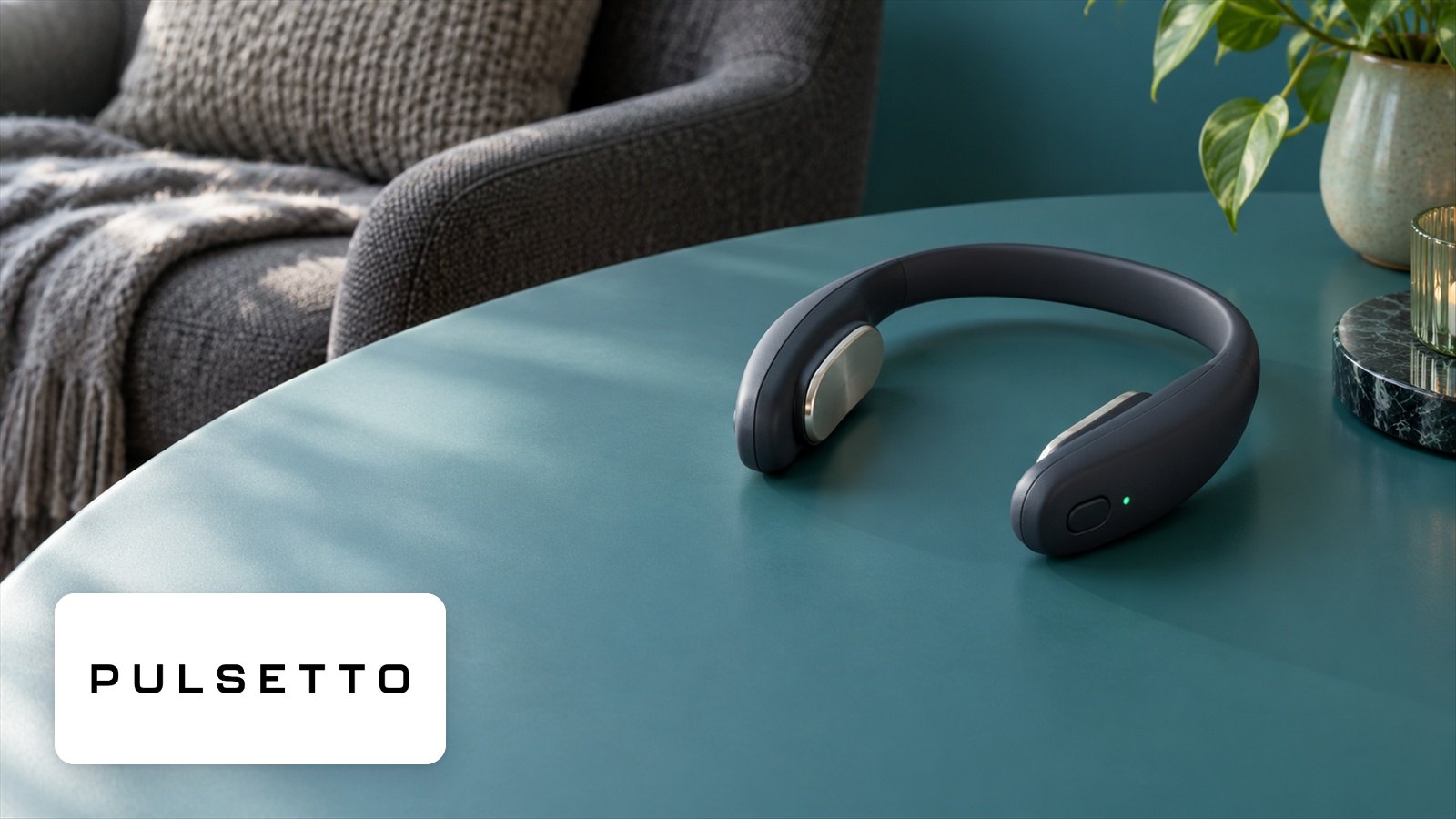
Pulsetto is a 60g band that sits around the back and sides of your neck and sends low-level electrical pulses toward the vagus nerve. It is made by UAB Pulsetto, a Lithuanian company registered at Delcios 29 in Vilnius, and sold direct from its own Shopify store to customers worldwide.
You apply a thin layer of conductive gel, put the band on, and run a session from the phone app. The free tier of the app carries five programs: Stress, Sleep, Calm, Focus and Release. Standard sessions run four minutes; the sleep protocol runs ten.
Three models are on sale. Lite is the entry device, with seven intensity levels and about 20 sessions per charge. FIT adds two more intensity levels and roughly 30 sessions, and FIT X is the flagship, adding adaptive stimulation, contact sensing and offline sessions that run without your phone nearby. All three charge over USB-C in about an hour.
- Sessions are four minutes, which is the single biggest reason testers kept the habit going.
- Every session needs conductive gel. The box includes a 30-day tube; refills are $12, or $45 for four.
- The app works free. The Premium tier is a separate, optional purchase.
- Terms are better than the category norm: free worldwide shipping, a 30-day money-back window and a two-year warranty.
- The nerve-stimulation science is real, but published trials on this specific device are limited.
What buyers and testers report
The sources broadly agree on the shape of the experience: nothing dramatic on day one, a modest shift after a few weeks of near-daily use, and sleep as the benefit people notice first.
| Source | What it found | Checked |
|---|---|---|
| Trustpilot, 3,469 verified buyer ratings | 4.1 out of 5; 78% of ratings are four or five stars, 16% are one star | 18 Oct 2026 |
| Wareable, hands-on over several weeks | 4.5 out of 5; no immediate effect, then a subtle sleep improvement at about four weeks | Oct 2026 |
| DIY Genius, hands-on over three months | Recommends it; relaxation within minutes, and flags gel friction and limited device-specific trials | Oct 2026 |
| MillennialHawk, compiled review | Positive; rates it better value than Apollo Neuro | Oct 2026 |
| Pulsetto product and safety pages | 4-minute sessions, 7 to 12 day battery, 2-year warranty, 30-day refunds, published contraindication list | 17 Oct 2026 |
| Peer-reviewed stimulation research | Measured effects on heart-rate variability vary by a person's starting baseline | 2025 to 2026 |
Pulsetto says more than 330,000 customers have bought from it. On the one-star end of Trustpilot, the three recurring themes are app billing, a unit failing early, and support being slow to resolve an account problem. Those matter, and we have scored them, but they sit against a clear majority of satisfied buyers.
Does the app cost extra?
This is where our sources genuinely disagree, so it is worth untangling. One hands-on tester describes the app as free with no paywalled features, while several Trustpilot buyers report Premium charges they did not expect.
Both are describing real things. The device works on the free app tier, with all five core programs and soundscapes included, so you can buy Pulsetto and never pay again. Premium is a separate product that adds guided breathing, meditations, affirmations and finer pulse control.
Premium is listed at $15 a month after a 14-day trial, or prepaid at $97 for twelve months, $125 for twenty-four and $175 for thirty-six. If you only want the five core programs, decline the trial or cancel it in the app before it converts.
If you do start the Premium trial, set a reminder for day 13. The prepaid plans are much cheaper per month than the rolling one, so if you know you want Premium, buying twelve months outright costs less than seven months of rolling billing.
What you pay, and for which model
All three devices are currently marked down, with the autumn promotion taking up to $250 off list price. These were the live prices when we checked on 18 October 2026.
| Model | Price | Battery | What you get over the model below |
|---|---|---|---|
| Pulsetto Lite | $269 | 7 days, about 20 sessions | Entry model: 7 intensity levels, the five core programs |
| Pulsetto FIT | $296 | 10 days, about 30 sessions | 9 intensity levels, slimmer build, basic activity tracking, wider app access |
| Pulsetto FIT X | $350 | 12 days | Adaptive stimulation, contact sensing, offline sessions |
At $27 more than Lite, FIT is the one most people should price up first: it is the smallest step in cost and the largest step in intensity range and battery. FIT X earns its $350 only if running sessions away from your phone matters to you.
Running costs are the gel and nothing else. A 60g tube ships in the box and covers about 30 days of daily use; refills are $12 a tube or $45 for a four-pack. Accessories are optional: a travel case at $44, and a five-year warranty extension at $39 that replaces the standard two years.
Two discounts are worth knowing about before you check out. Pulsetto runs verified programs for students, serving and veteran military personnel, seniors and healthcare staff, each behind third-party verification, and its referral scheme gives a friend $50 off with $10 in store credit back to you. US buyers can also pay from an HSA or FSA card through a dedicated product listing, which needs a qualifying letter of medical necessity via Truemed. Codes cannot be stacked, so compare the sale price against the best single code rather than assuming they combine.
What works well and what to check
What works well
- Four-minute sessions. Every hands-on tester credited the short format for making the routine stick.
- Sleep is the most commonly reported gain, across both Trustpilot buyers and the independent testers.
- Battery measured in days, not hours, so charging is a weekly job at most.
- Terms beat the category: free worldwide shipping with no minimum, 30-day money-back, two-year warranty.
- Priced below the ear-worn and vibration alternatives, and HSA or FSA eligible for qualifying US buyers.
What to know before you buy
- Read the contraindication page before ordering. It rules out several conditions, and that is the single check most likely to change your decision.
- Gel is required every session, and multiple testers called the wet step the main daily friction. Budget for refills if you plan to use it daily.
- The Premium app trial converts to billing. Cancel inside 14 days if you only want the free programs.
- A minority of buyers report a unit failing in the first weeks. That is what the 30-day refund and two-year warranty are for, so register the purchase and keep the receipt.
- Published research specific to this device is limited, so set your expectations from the fourth week rather than the first session.
Who should not use it
Pulsetto publishes a clear contraindication list, and it is longer than most wellness gadgets. We are repeating it because it is the most useful thing on this page for some readers.
The brand's safety page says not to use the device if you have an active implanted electronic device such as a pacemaker or a hearing implant, or metal hardware such as a stent, plate or screw at or near the neck. It also excludes pregnancy, children, active cancer or cancer in remission, abnormal cervical anatomy, and a history of brain tumour, aneurysm, bleed, head trauma, fainting or seizures.
Pulsetto also states that it has not been evaluated in people with uncontrolled blood pressure, an abnormally slow or fast heart rate, or existing cardiac disease. Speak to a clinician first if any of that applies to you.
How strong is the evidence
Stimulating the vagus nerve is established medicine in specific clinical settings, and non-invasive stimulation is an active research field. That is the honest starting point, and it is not the same thing as proof that one consumer device produces a given result.
The research on non-invasive stimulation and heart-rate variability is still being argued out. A 2025 study published in Translational Psychiatry found that response depends on where a person starts: participants with low baseline variability saw a blunted stress response restored, while those who already measured high saw their heart rate and variability fall relative to a sham. Other work has measured a rise in variability during stimulation without a matching change in how stressed people reported feeling.
Pulsetto is sold as a general wellness product, not a medical device, and it is not FDA-cleared or approved to treat any condition. The company describes itself as FDA-registered, which is a listing requirement for certain electronic products sold in the US rather than a review of effectiveness. That positioning is normal for this whole product category, and it is the reason we scored the evidence dimension 6.0 rather than higher.
Who it suits best
Buy it if you want a physical cue that starts a wind-down routine, you have four minutes most evenings, and you clear the safety list. Buyers who report the clearest results are the ones who used it near-daily for a month rather than occasionally.
Consider an alternative if a wet gel step every session is a dealbreaker, if you want to stimulate while walking around, or if you need something cleared to treat a diagnosed condition. In that last case the conversation belongs with a clinician rather than a shopping page.
Three alternatives worth comparing
- Truvaga Plus, around $349. Also a neck-placed electrical stimulator, with two-minute sessions instead of four. Prefer it if you want the shortest possible session; it needs gel too.
- Nurosym, around 700 euros. Ear-worn rather than neck-worn, with 15 to 30 minute sessions. Prefer it if ear placement suits you better and the higher price is acceptable.
- Apollo Neuro, $349 to $448. A wrist or ankle wearable that uses silent vibration rather than electrical stimulation, with an optional $99 a year plan. Prefer it if you want no gel and no electrodes, and you want to wear it while moving.
Questions buyers ask
Does Pulsetto actually work?
Based on the sources we compiled, most buyers report a modest benefit and sleep is the gain named most often, but it builds over weeks rather than arriving in the first session. Trustpilot's 3,469 ratings average 4.1 out of 5, and the hands-on tester who tracked it longest reported a subtle change at around four weeks. Independent trials on this specific device are limited, so the 30-day money-back window is the practical way to find out whether you are a responder.
Is Pulsetto FDA approved?
No. Pulsetto is sold as a general wellness device and is not FDA-cleared or FDA-approved to treat any medical condition. The company describes the device as FDA-registered, which means it is listed with the agency as required for certain electronic products, not that the agency has reviewed its effectiveness.
Do you need a subscription to use Pulsetto?
No. The free tier of the app runs all five core programs, so the device is fully usable without paying anything further. The Premium tier is optional and adds guided breathing, meditations and advanced pulse control at $15 a month after a 14-day trial, or less per month if you prepay twelve, twenty-four or thirty-six months.
What is the difference between Pulsetto Lite, FIT and FIT X?
Lite is the entry model at $269, with seven intensity levels and about 20 sessions per charge. FIT costs $296 and adds two more intensity levels, roughly 30 sessions per charge, a slimmer build and wider app access. FIT X is $350 and adds adaptive stimulation, contact sensing and offline sessions that run without your phone.
Can you return Pulsetto if it does not work for you?
Yes. Pulsetto offers a 30-day money-back guarantee on devices, alongside a two-year warranty that can be extended to five years for $39. Check the current refund policy on the merchant's own page before ordering, since the conditions attached to a money-back claim are set there.
Does Pulsetto need gel for every session?
Yes. Conductive gel goes between the electrodes and your skin for each session, and testers consistently name this as the main daily inconvenience. A 60g tube covering about 30 days of daily use ships in the box; replacements cost $12 a tube or $45 for a four-pack.
Bottom line
Our compiled score is 7.6 out of 10, and our confidence in it is moderate: the hardware, pricing and after-sales facts are well documented, while the question of how much you personally will feel is the part no source can settle for you. The device is cheaper than its main rivals, the terms are genuinely good, and the four-minute session is the detail that makes people keep using it.
Clear the safety list, decide whether a nightly gel step is acceptable, and use the 30-day window as a real trial rather than a formality. If you are buying now, the autumn promotion is taking up to $250 off the three devices, and the current sitewide code is the best single discount we were able to apply at checkout.