Software, AI & Learning · Review

Most people come to Coursera with a simple hope: learn real, usable skills from serious universities and brands without going back to campus or taking on a second mortgage. The platform has become one of the default places to look for online degrees, Google or Meta‑branded certificates, and structured courses that feel more like a real class than a random YouTube playlist.
More than a decade in, that glossy picture is partial. Independent reviewers praise Coursera’s university‑level content, flexible formats, and the credibility that comes with big‑name partners. At the same time, they point out confusing pricing, uneven course quality, low instructor interaction on some tracks, and the simple truth that you still need time, discipline, and a clear goal to get value out of it.
This Coursera review is for learners who are trying to decide whether to double down on Coursera in 2026: people choosing between free auditing and paid certificates, workers eyeing Google or Microsoft career tracks, and professionals wondering if Coursera Plus or even a full online degree is actually worth it. The goal is not to sell you on online learning, but to show what long‑term users, independent bloggers, and review platforms actually say about daily use, so you can decide if Coursera fits your goals, budget, and learning style.
To do that, the review draws on:
What you’ll get from this Coursera review:
Coursera is a large online learning platform that partners with universities and companies to deliver courses, certificates, and full degrees. It started with massive open online courses and has grown into a catalog that spans data science, business, tech, languages, and more. Learners can audit many classes for free or pay for graded assignments, certificates, and structured programs.
The platform hosts content from well‑known universities and brands, and presents it in a familiar course format. Most classes include pre‑recorded video lectures, readings, quizzes, and sometimes peer‑reviewed projects.
Discover firsthand opinions about Coursera. Is it a hit or miss? We’ve aggregated user and pro reviewers feedback for you. below are the key takeaways:
"Wide range of courses: Offers a vast selection, ensuring something for everyone."
"Flexibility: Learn at your own pace, making it ideal for busy professionals or those with other commitments."
"Recognized certificates: Certificates are generally trusted by employers."
"Financial aid available: Provides financial assistance to those who cannot afford paid courses, making education more accessible."
"Professional service."
"University-level content quality."
"A variety of learning options."
"The possibility of getting a full degree online."
"Coursera has partnered with over 325 top universities and organizations, including Imperial College London, Stanford University, Google, and IBM, to create high-quality learning programs."
"Coursera’s course prices are affordable, and its degree programs are significantly cheaper than traditional on-campus degrees."
"Coursera offers fully accredited degree programs online from top universities at a fraction of the cost of in-person degrees. This makes higher education more accessible and budget-friendly."
"Matriculated degree programs with colleges and universities."
"Partners with private corporations for job-specific skills and certificates."
"Robust language support."
"You can actually use Coursera for free if your government provides free subscription / scholarship."
"A lot of Professional Certificate are actually well-made. I absolute enjoyed the Google IT Support, Google Cybersecurity, and Google Project Management."
"You can learn and accomplish anything you do in Coursera in your own pace."
"I liked the combination of lectures and quizzes in the courses. I thought it helped compared to just passively watching videos."
"Coursera is a pretty solid platform for online learning. The site is user-friendly: the interface is intuitive, everything loads quickly, videos play without any issues, and navigating courses and tracking progress is straightforward. The mobile app is reliable too if you want to study on the go.One of the big pluses is that there are some really great courses from top universities and companies. A few of them are totally worth the money: the content is well-structured, the instructors know their stuff, the assignments are useful, and you actually feel like you've leveled up your skills afterward. No regrets paying for a certificate or subscription on those."
"I really don't understand the negative reviews. I find the website really easy to use. I have used live chat a few times and my problems have always been solved. I purchased a yearly plus subscription for just over £100 and i have completed many courses now and received my certificates. The certificates may not get you a job but they will definitely help and i've learned some really valuable skills . Most of the negative reviews seem to be money related for some sort of trial they were running .. so don't let it put you off. There are some great courses on here from accredited companies like Microsoft, Google , IBM etc ..."
"Complicated pricing scheme: Pricing options (individual courses, specializations, subscriptions) can be confusing."
"Non-accredited courses: While useful for skill development, they may not carry the same weight as accredited programs."
"Financial aid application process: The process can take up to 16 days for review, which may be too long for some learners."
"Complex pricing structure."
"Coursera’s pricing structure can be confusing due to multiple subscription plans, individual course fees, and degree program costs. It may take time to figure out the best option."
"Some courses, especially in advanced subjects like data science and programming, require prior knowledge, making them less beginner-friendly."
"Instructor feedback varies by course. While some programs offer direct interaction, many rely on peer grading and automated assessments, which may not be ideal for learners seeking personalized guidance."
"No longer has truly free courses."
"Could improve some navigation options."
"The dreaded Peer Review. It may take forever for your submission to be checked by someone."
"In some Professional Certificate, the lecturer just say what you need to learn and didn't bother demonstrate how you do it in real practice. Like installing a server operating system into a server hardware. It's hard to imagine and visualize it. It's super easy to learn when you show how to do it, and you're actually practicing it, instead of memorizing how to theoretically do it."
"In almost all IBM certificate, they used an A.I. robot voice which I find very annoying, it's like a screeching noise of chalk against a blackboard."
"Worst customer service I've ever experienced. They "tricked" me into a $400+ subscription auto-renewal (I thought I cancelled and I'm still not entirely convinced that I didn't). When I attempted to get a refund, I had multiple customer service reps respond by dropping a link to their refund policy and terminating the chat while I was typing my response. Sketchy business practices and horrible customer service. AVOID."
"predatory trial system, same as other reviewers mentioned. never again.
Also, contact us routes you to email AI, you have to ask to speak to a human, and support person closes ticket when issue is unresolved. gross."
"It is impossible to get a refund. They use the most annoying tactics to not have to refund you. Like emails have to be responded to in 24 hours other wise they close the case, they send you an CS email to help but it's empty and so they close the case. I asked for a refund for 2 weeks, even after I closed down subscription, they charged me and because I didn't notice the charge - after 7 days the window for refund is closed. 3 weeks and many hours typing many emails to them with documents to prove ...all I get is a "sorry no refund please see our refund policy" generic response."
"Overall, Coursera is considered a great platform compared to its competitors, offering a comprehensive and cost-effective solution for online learning. Its wide range of courses, affordability, and credible certifications make it an attractive option for learners worldwide."
"To sum up this Coursera review, I can say that it stands as a robust platform for online learning and offers a plethora of courses across various disciplines. Its partnerships with universities and institutions add a layer of credibility to its courses, many of which are adaptations of existing on-campus offerings.
Even though Coursera's pricing model is a bit complex and may require some time to navigate, its varied learning paths, from free-to-audit courses to full degrees, make it a versatile choice for learners of all levels."
"Coursera is one of the most popular online learning platforms on the market. Its diverse range of courses and learning programs make it a standout platform. It’s an ideal choice for someone looking for a career change, study a degree online or simple learn a new skill. Its courses and programs are designed in partnership with top Universities and Organizations, means you are learning from the very best. It is an inexpensive and convenient way to learn and if you aren’t ready to commit, you can get started with one of its free previews or the free trial with Coursera Plus."
"Although it's still an excellent place to pick up a new skill, the for-profit company has drastically cut back on how much it gives away. Now, you need a $59-per-month subscription or an individual, flat-rate course to get anything useful. Coursera is still a worthwhile option, especially if you're looking to gain a job-specific certification."
"In any method, in any platform, the value of what you get is in the actual learning itself. I learned a lot from Coursera."
"Looking at the most recent data from 1,031 reviews to see what real customers are saying.
77% of users gave the platform the worst rating possible.
The Happy Minority (13%): On the other hand, 13% of users (5-star and 4-star) say they had a good experience, and they are often confused by the bad reviews.
Overall, most reviewers were not happy with their experience. Consumers also say that billing problems, free trials, and refund problems are deceptive practices."
"Coursera is a top-tier online school. It puts the university lecture hall right in your browser. But it also brings with it the red tape of tuition and strict grading systems.
Most value for:
PCMag and Upskillwise say that Coursera is great for career advancement, but Trustpilot users say that the support is not as good. If you need a verified certificate from a top-tier brand to make your LinkedIn profile stand out, it's worth the money. If you want a relaxed, low-stakes place to learn or good customer service, don't bother. It is still the best way to prove your credentials, but not always the best way to use the site."



Many courses offer free previews or audit access, allowing you to watch video lectures and read materials. However, graded assignments and certificates require payment. Not all courses have a free audit option.
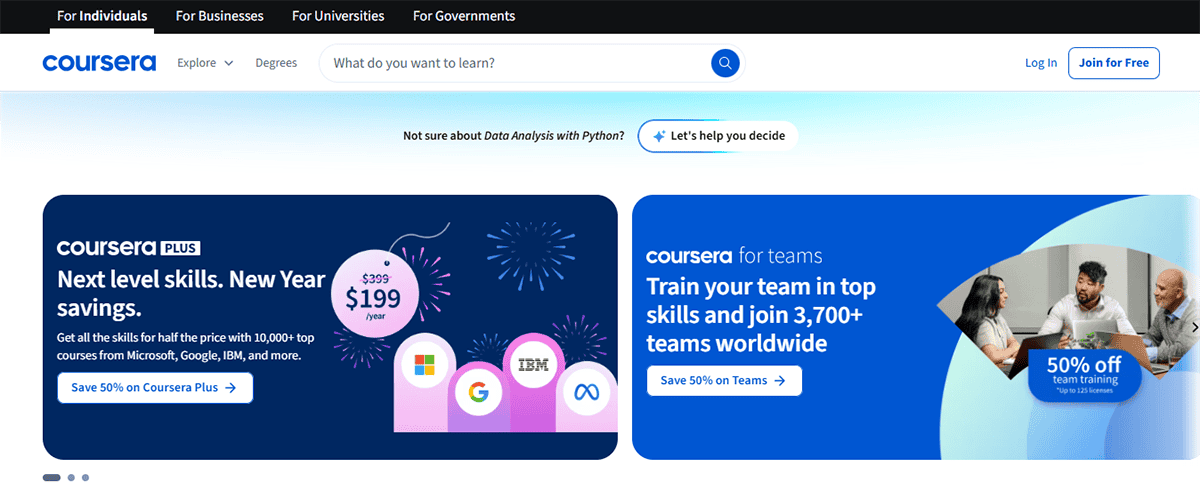
Coursera Plus is a subscription giving unlimited access to 7,000+ courses, specializations, and certificates for a flat monthly or annual fee. It’s best value if you plan to take multiple courses or earn several certificates in a year.
Degrees are fully accredited and issued by partner universities. Certificates from universities or industry leaders (like Google, IBM) are widely recognized by employers, though not equivalent to a formal degree.
Many learners report career benefits, including promotions and new jobs, especially with professional certificates in high-demand fields. Employer recognition is strongest for certificates from well-known universities and companies.
Sign up for a free Coursera account, find your desired course, and click “Enroll.” Choose to pay, apply for financial aid, or preview/audit the course if available.
Quizzes are auto-graded. Essays and projects are graded by peers or, in some regions, by AI for faster feedback. Peer review requires you to grade others’ work using a rubric before receiving your own grade.
You can get a full refund for individual courses and annual Coursera Plus within 14 days of purchase (unless you’ve earned a certificate). Monthly subscriptions and guided projects are non-refundable. Cancel subscriptions anytime; access continues until the end of the billing period.